The Northern Mariana Islands Labor Stabilization Act
When the Transition Becomes the Destination: On H.R. 9787

What if a government program designed to disappear became permanent instead?
There is an old saying that nothing is more permanent than a temporary government program. Whether that observation is fair or cynical is open to debate, but every so often a proposal comes along that makes the saying difficult to ignore.
This week, Congresswoman Kimberlyn King-Hinds introduced H.R. 9787, the “Northern Mariana Islands Labor Stabilization Act.” At the time of this writing, the full text of the bill has not yet been published on Congress.gov, so my observations are based entirely on the news reports describing its contents. If those reports accurately reflect the legislation, however, this proposal deserves careful attention, not simply because of what it would do, but because of what it suggests about the path the Commonwealth has been following since federalization began nearly two decades ago.
According to those reports, the bill would replace the existing Commonwealth-Only Transitional Worker (CW) program with a labor stabilization framework extending through at least December 31, 2039. It would raise the annual permit cap to as many as 15,000 workers, restore legal status to certain longtime residents, eliminate the touch-back requirement for many workers, expand eligibility for construction occupations, and authorize the Secretary of Labor to continue the program for as many as ten additional years if future labor conditions justify doing so. One seemingly minor provision also caught my attention. The legislation would retire the term “Commonwealth-Only Transitional Worker” altogether, replacing it simply with “Commonwealth-Only Worker.”
Taken on their own, many of these proposals are neither surprising nor unreasonable.
Anyone who has lived in the Commonwealth over the past few decades understands the uncertainty that has surrounded the CW program. Employers have struggled to make long-term business decisions while permit caps and regulations continued to change. Longtime workers have built careers, supported families, and become part of the fabric of our community while never knowing whether another renewal would allow them to remain. Whatever one's views on immigration policy may be, those uncertainties have been real, and any serious proposal should be judged in part by whether it addresses them fairly.
Congresswoman King-Hinds described the legislation as replacing "policies that were never intended to become permanent" with a more stable and predictable framework. I have no reason to doubt the sincerity of that objective. Stability is something the Commonwealth has often lacked since federalization, and it is understandable why employers, workers, and policymakers alike would welcome greater certainty after years of operating under a system that has been extended, revised, and adjusted time and again.
Yet it was that very phrase, “never intended to become permanent,” that stayed with me after I finished reading the article. Because it reminded me that the CW program was never intended to become permanent either.
When Congress federalized the Commonwealth's immigration system, the CW program was presented as a transition. The Commonwealth would gradually reduce its dependence on imported labor while moving toward the federal immigration system used throughout the rest of the United States. The transition might not be easy, and it might require periodic adjustments, but the destination itself seemed reasonably clear.
Nearly twenty years later, we are discussing legislation that would extend the program until at least 2039 while increasing the number of permits available each year. I mention that not because I oppose every provision in the bill. In fact, several appear to address genuine problems that have existed for years. Rather, I mention it because I found myself asking a question that has been growing in the back of my mind for some time:
Has the transition quietly become the destination?
I’m not asking that rhetorically. I ask it because I think that is the question that must be answered before we can have an informed discussion about where the Commonwealth goes from here.
Over the past several years, public debate has tended to focus on each new extension, each new permit cap, each new administrative change, and each new deadline. Those conversations have all been important, but they have also been remarkably narrow. We rarely stop to ask how those individual decisions fit together, or whether they still point toward the same destination that was described when federalization first began. Perhaps they do. Perhaps they don't.
Before deciding whether H.R. 9787 represents the right course for the future, I think it’s worth taking a step back and remembering what federalization was originally intended to accomplish. Only then can we have an honest conversation about whether this proposal represents another step along that path, or whether it acknowledges that we have, almost without realizing it, chosen a different one.
The Forgotten Promise of Federalization
To understand why H.R. 9787 caught my attention, I think it helps to remember what Congress was trying to accomplish when it federalized the Commonwealth's immigration system.
When people talk about federalization today, the conversation usually begins with the CW program. That makes sense because the CW program has been part of the Commonwealth's daily life for almost two decades. There are adults living in the CNMI today who have never known anything else. Permit caps, renewals, and periodic extensions have become so familiar that it’s easy to forget they were never intended to define federalization. They were intended to manage the transition.
That transition began with the Consolidated Natural Resources Act of 2008.
Congress decided that U.S. immigration law would be extended to the Commonwealth, ending the locally administered immigration system that had existed for decades. The reasons for doing so were debated then and are still debated now. There were concerns about labor abuses, immigration enforcement, and whether the Commonwealth should continue operating under an immigration system separate from the rest of the United States. There were also concerns there at home that Washington did not fully understand the Commonwealth's economy or appreciate how dependent it had become on foreign labor. Congress acknowledged those realities in the law itself.
The purpose of federalization was not simply to replace one immigration system with another. It was to bring the Commonwealth under federal immigration law while phasing out the CNMI's nonresident contract worker program in a way that minimized unnecessary economic disruption. At the same time, Congress sought to strengthen worker protections, improve immigration enforcement, and create conditions that would support the Commonwealth's long-term economic growth. That is why Congress created the Commonwealth-Only Transitional Worker program.
The program was never described as a permanent solution. DHS later explained that the CW classification was created to provide an orderly transition from the Commonwealth's permit system to the federal immigration system because Congress recognized that employers could not replace thousands of workers overnight. The transition would take time, and the CW program was intended to provide that time.
Whether Congress underestimated how difficult that transition would be is something people may continue to debate. The Commonwealth is not like any of the fifty states, and its economy has always faced challenges that are difficult to appreciate from Washington. Population decline, recessions, typhoons, changing tourism markets, and a limited local labor pool all complicated a transition that was never going to be simple. None of that changes what Congress originally set out to do.
Before we decide whether the Commonwealth should continue along its present course, I think it is worth remembering what that original course was supposed to be and how things actually played out over the years.
The Transition Years
Federal immigration law took effect in the Commonwealth on Nov. 28, 2009, ending the CNMI’s locally administered immigration system and beginning the transition Congress had established under the CNRA. The Commonwealth-Only Transitional Worker program allowed employers to continue hiring foreign workers who did not qualify under existing federal visa categories while businesses, workers, and government agencies adjusted to the new system.
Much of the discussion during those early years focused on implementation. Employers had to learn new filing procedures and federal requirements. Workers who had lived and worked in the Commonwealth for years found themselves dealing with a different legal framework. Attorneys, businesses, and government offices spent years trying to understand how the new rules would be applied and what would happen as each new deadline approached.
What federalization did not change was the Commonwealth’s dependence on foreign labor.
That dependence had developed over decades and was tied to the structure of the local economy. Hotels, restaurants, construction companies, retailers, health care providers, and many other employers continued to rely on workers from outside the Commonwealth. Changing the agency responsible for immigration did not change the size of the local labor force or the number of workers businesses needed to remain open.
As the transition moved forward, Congress and the Department of Homeland Security continued making changes to the program. Regulations were revised. Numerical limits were adjusted. Filing requirements and eligibility rules changed. Employers tried to plan around deadlines that could determine whether they would be able to retain experienced workers, while workers and their families waited to learn whether they would be allowed to remain employed in the Commonwealth.
These discussions returned repeatedly over the years. Business organizations asked Congress for more time. Employers warned that the local workforce was not large enough to meet existing demand. Workers who had spent years building their lives here asked for greater stability. Local officials traveled to Washington, testified before Congress, wrote letters, and argued that the transition could not be completed without causing serious harm to the economy.
Congress responded by extending the program and revising parts of it. Federal agencies continued issuing regulations and guidance as new questions arose. Some changes gave employers more time. Others created new requirements and new uncertainty. The numerical cap became a recurring subject of debate, along with questions about who qualified, how long workers could remain, and what employers would have to do to keep them.
The touchback requirement became one of those recurring concerns. Under the current law, CW workers are required to spend at least 30 days outside the Commonwealth every 3 years before returning for another employment term. Employers have criticized the requirement because it can interrupt operations and separate workers from the jobs and families they have maintained here. Workers have criticized it because many of them have lived in the Commonwealth for years and do not view leaving the islands as a simple administrative matter. H.R. 9787 now proposes removing that requirement.
While these debates continued, the Commonwealth faced problems that Congress could not have predicted back in 2008. The economy moved through periods of growth and decline. Visitor arrivals changed from year to year. Super Typhoon Soudelor struck in 2015 and caused widespread damage, creating years of rebuilding and a continued need for construction workers and skilled labor. The COVID-19 pandemic later brought international tourism to a halt and forced businesses throughout the islands to reduce operations, close temporarily, or shut down altogether.
Each new crisis affected the labor discussion. During recovery periods, businesses needed workers to rebuild and reopen. During downturns, employers struggled to survive while also dealing with permit costs, deadlines, and changing federal requirements. The debate over the CW program continued because the conditions that had made the Commonwealth dependent on foreign labor had not gone away.
Over time, the questions also began to change.
The early discussion focused on how the Commonwealth would complete the transition and eventually move beyond the CW program. Later discussions focused more often on how many workers the program should allow, how long it should continue, which requirements should be changed, and how employers could receive more certainty from year to year.
Those changes did not come from one decision. They accumulated through extensions, revised caps, new regulations, economic emergencies, natural disasters, and repeated requests for additional time. Each decision addressed the problem immediately in front of Congress or the federal agencies responsible for the program.
After enough years, the temporary system became familiar to everyone involved. Employers planned around it. Workers planned their lives around it. Government agencies administered it. Local leaders defended it. The public learned to expect another debate whenever a deadline approached.
The transition continued, but the original expectation that the Commonwealth would eventually move beyond it became less visible with each passing year.
The Next Generation
For most of the past two decades, the Commonwealth's labor system and the debate over birthright citizenship have existed as separate conversations. One centered on economics and workforce needs. The other centered on constitutional law and immigration policy. There was little reason to think the two would ever intersect, but that may no longer be true.
As Congress considers H.R. 9787, it is also considering the Ban Birth Tourism Act of 2026. The two bills address entirely different subjects. H.R. 9787 would extend and expand the Commonwealth's unique labor program. The Ban Birth Tourism Act would limit birthright citizenship in the territories by providing that children born after January 1, 2027, to parents who are not U.S. citizens, U.S. nationals, or lawful permanent residents would not acquire U.S. citizenship at birth.
Supporters of the Ban Birth Tourism Act argue that birthright citizenship has created incentives for noncitizens to enter the United States temporarily for the purpose of giving birth. Whether that concern justifies changing long-standing law is a debate for Congress to resolve. My purpose here is not to revisit that broader debate, but to ask whether the Commonwealth's experience fits comfortably within the assumptions on which it is based.
Congress has spent nearly twenty years acknowledging that the Commonwealth is different.
When it enacted the CNRA, Congress created the CW program because existing federal immigration categories could not meet the Commonwealth's labor needs without causing severe economic disruption. When the original transition period proved insufficient, Congress extended it. As additional challenges arose, Congress extended it again. H.R. 9787 would continue that pattern by extending the program through 2039, increasing the annual cap, proposing the elimination of the touch-back requirement, and renaming the Commonwealth-Only Transitional Worker program as the Commonwealth-Only Worker program. Those decisions have produced consequences that could not have been fully anticipated in 2008.
Workers who first arrived under what was expected to be a temporary transition program have now spent much of their adult lives in the Commonwealth. Some have established businesses. Others have purchased homes, raised families, become active in their churches, coached youth sports, volunteered in community organizations, and built lives that are, in every practical sense, rooted in these islands. Their legal status has remained temporary, but the lives they have built here are anything but temporary.
I understand part of that experience from a different perspective. I was born in the CNMI to guest worker parents and grew up as a U.S. citizen. Even with the legal certainty that citizenship provided, there were still moments growing up when many of us questioned where we truly belonged. We were born there. We were raised there. These islands were home. Yet being the children of guest workers often meant feeling different from our classmates in ways that are difficult to explain to someone who did not grow up there.
That experience has stayed with me because it reminds me that legal status is only one part of belonging. Community, identity, and home are shaped over a lifetime.
If both H.R. 9787 and the Ban Birth Tourism Act were enacted, the next generation of children born in the Commonwealth could begin that same search for belonging without even the legal certainty that my generation possessed. They would be born into a Commonwealth where Congress had concluded that their parents were needed to sustain the islands' economy while also concluding that birth in the Commonwealth no longer carried the same legal consequence that it once did.
Whether Congress should make that change is ultimately a matter for Congress to decide. My point is simply that the Commonwealth's history deserves to be part of that conversation. The circumstances that exist here today are not accidental. They are the product of nearly twenty years of federal policy, and any discussion about the future should begin with an honest understanding of how we arrived here.
Our Responsibility
Whether H.R. 9787 becomes law, whether the Ban Birth Tourism Act of 2026 becomes law, and how Congress chooses to balance the Commonwealth's economic needs with federal immigration policy are decisions that will ultimately be made in Washington. The people of the Commonwealth cannot vote on those bills, but we are not without a voice. We can still decide what we are willing to ask Congress to do, what kind of community we want to become, and whether our treatment of long-term foreign workers reflects the values we so often claim as our own.
Throughout this discussion, I have referred repeatedly to the CW program because it is the subject of H.R. 9787. Yet the Commonwealth's dependence on foreign labor did not begin with federalization in 2009. Long before the CW program existed, tens of thousands of men and women came to the Northern Mariana Islands under the Commonwealth's own guest worker program. Many remained through the transition to federal control and became CW workers without ever leaving the islands they had already called home for years, or even decades.
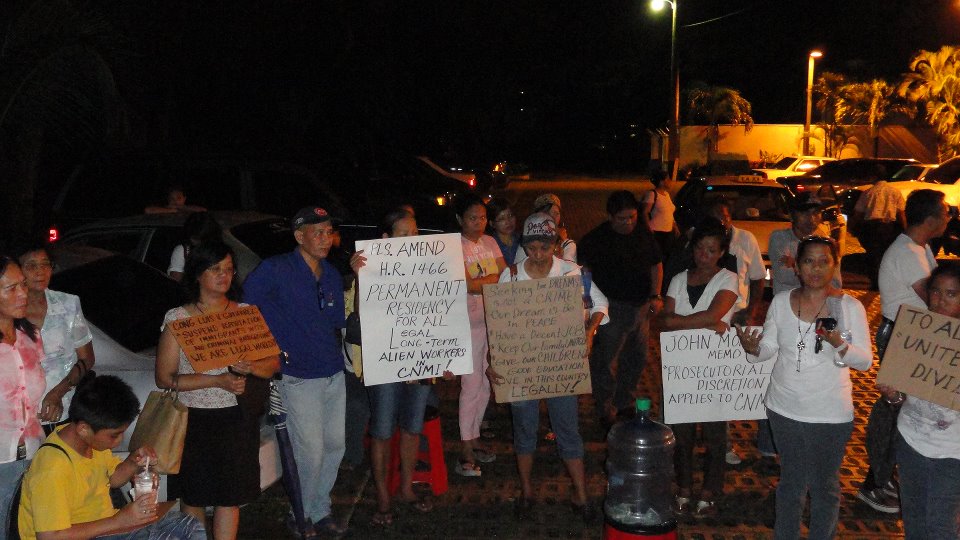
There are still hundreds, if not thousands, of people in the Commonwealth who have lived and worked there for thirty or forty years. Some may have been there even longer. They have spent most of their adult lives in these islands. They have raised children and grandchildren there, endured recessions, survived typhoons, lived through the collapse of the garment industry, remained through the COVID-19 pandemic, and continued contributing to the Commonwealth through every period of uncertainty. The law has continued to describe them as temporary workers, but nothing about the lives they built there has been temporary.
That reality deserves serious reflection in a Commonwealth where most people identify as Christians and where the Roman Catholic Church remains a central part of community life. Every weekend, churches throughout the islands are filled with citizens and foreign workers praying beside one another. Families whose roots in the Marianas stretch back generations worship beside families who first arrived under the old guest worker program. They hear the same Gospel, receive the same sacraments, and profess the same belief in the dignity of every human being.
It is easy to welcome someone as a brother or sister inside a church. The harder question is whether that recognition follows them outside its doors.
For decades, we have accepted the labor of foreign workers while withholding any meaningful way for many of them to become permanent members of the country and community they helped sustain. We have depended on them to build our homes, care for our elderly, serve our tourists, teach our children, staff our businesses, repair our infrastructure, and keep our economy functioning. We have called upon them after typhoons, during labor shortages, and through periods when the Commonwealth's own survival appeared uncertain. Many answered that call year after year while remaining legally temporary.
I believe the Commonwealth should begin advocating for a meaningful pathway to lawful permanent residency for long-term workers who have demonstrated their commitment to these islands. For those who have obeyed the law, supported their families, contributed to the community, and made the Commonwealth their permanent home in every practical sense, that pathway should include the opportunity to pursue U.S. citizenship.
This would not erase the distinction between lawful immigration and unlawful immigration, nor would it require Congress to grant permanent status without conditions. Congress could establish reasonable requirements based on years of lawful residence, employment history, good moral character, family ties, community service, or other evidence of long-term commitment. What it would do is recognize that a person who has lived and worked in the Commonwealth for most of a lifetime is no longer meaningfully described as a temporary guest.
Instead, the Commonwealth is once again asking Congress to extend the program, raise the annual cap, and open the doors for thousands of additional temporary workers in the years ahead. We are asking for more workers while many of those who came before them, including people who arrived under the old CNMI guest worker program decades ago, still have no secure place in the country they helped build. If the Ban Birth Tourism Act also becomes law, some of their children and grandchildren may grow up in the Commonwealth without even the U.S. citizenship that gave my generation at least some legal certainty in the only home we had ever known.
If someone can spend an entire lifetime helping build the Commonwealth, only to see their children grow up without being recognized as Americans in the only home they have ever known, what does it really mean to belong here?