Why the CNMI Changes the Birthright Citizenship Debate
Lessons From an American Immigration Experiment

Every generation inherits the responsibility of deciding who may enter the country, under what conditions they may remain, and what obligations a nation owes both to its own citizens and to those who come here seeking opportunity. Those questions are as old as the Republic itself, and they have never been easy to answer. It should come as no surprise, therefore, that immigration once again finds itself at the center of our national conversation.
The latest chapter concerns birth tourism.
Senator Marsha Blackburn's recently introduced the Ban Birth Tourism Act of 2026 (S. 5023) seeks to address a practice that many Americans, regardless of political affiliation, find difficult to defend. If foreign nationals are deliberately traveling to the United States for the primary purpose of securing citizenship for their children through birth, Congress has every right to examine whether our immigration laws adequately address that practice. One need not oppose immigration to recognize that every sovereign nation has both the authority and the responsibility to protect the integrity of its immigration system.
I do not question Congress's authority to act.
What I question is something else entirely.
Experience has taught me that the greatest challenge in immigration law is rarely identifying the abuse one wishes to prevent. The greater challenge lies in ensuring that the legal tools created to prevent that abuse do not unintentionally burden people whose circumstances bear little resemblance to the problem legislators were attempting to solve. That distinction may seem subtle, but history suggests it is often where the most consequential mistakes are made.
Perhaps that is why, as I read through the text of S. 5023, my thoughts drifted not to Washington, D.C., nor to the southern border, but to the U.S. Commonwealth of the Northern Mariana Islands (CNMI).
For those unfamiliar with our islands, that may seem like an odd connection to make. Yet those of us who have lived through the Commonwealth's modern immigration history understand something that much of the country has never had reason to learn. Immigration policy is seldom experienced as an abstract legal framework. It is experienced by ordinary people attempting to live ordinary lives while navigating rules that are often anything but ordinary.
That realization was one of the principal reasons I wrote Shadows in Paradise.
Contrary to what some readers initially assumed, the book was never intended as an argument for or against any particular immigration policy. Nor was it written merely to preserve the history of the Commonwealth's guest worker system before those memories faded with time. Rather, it was born from a growing conviction that our islands had lived through an immigration experiment unlike any other under the American flag, and that the lessons learned there might one day prove valuable far beyond our shores.
I fear that day may have arrived.
One of the recurring themes throughout Shadows in Paradise is that immigration policies rarely unfold exactly as their authors envision. Legislators write laws to solve identifiable problems. Administrators develop procedures to implement those laws. Employers adapt to new regulations. Families adjust their lives around changing legal requirements. Years later, everyone discovers that the system which ultimately emerged differs considerably from the one originally imagined.
The federalization of the Commonwealth's immigration system offers a sobering example.
Whatever one's opinion of the locally administered system that preceded it, federalization was widely presented as an opportunity to establish greater consistency, stronger oversight, and a more stable legal framework. Many sincerely believed that bringing the CNMI under the federal immigration system would not only benefit U.S. citizens and permanent residents, but would also provide greater certainty and fairness for the tens of thousands of foreign workers who had built their lives in our islands.
Reality, however, proved considerably more complicated.
The federal government undoubtedly succeeded in bringing the Commonwealth under a single national immigration framework. Yet anyone who lived through those years also remembers that implementation was far messier than many had anticipated.
As the original transition deadline approached, it became increasingly apparent that the Commonwealth was nowhere near prepared for a complete phaseout of its foreign workforce. Businesses remained dependent upon employees who had spent years, and in many cases decades, living and working legally in the CNMI. Entire sectors of the local economy continued to rely upon their experience and institutional knowledge. Faced with that reality, the Commonwealth repeatedly petitioned Congress and the Department of Homeland Security for extensions of the transition period, arguing that the economy simply could not absorb such a dramatic change within the original timetable.
Those extensions did not occur because federalization had failed.
They occurred because governing reality proved more complicated than governing theory.
The eventual creation of the CW-1 program reflected that same reality. Intended as a temporary bridge while the Commonwealth adjusted to the federal immigration system, the program itself soon became the subject of repeated revisions, changing numerical caps, evolving eligibility requirements, shifting administrative guidance, and continuing uncertainty about its long-term future. Employers struggled to keep pace with new regulations. Workers often found themselves relying upon information that seemed to change from one year to the next. Even individuals who had spent much of their adult lives contributing to the Commonwealth discovered that each petition, each renewal, and each extension represented yet another reminder that the permanence they had quietly earned through years of lawful residence remained legally elusive.
Nor were these merely bureaucratic inconveniences.
Each filing carried a financial cost. Petition fees, renewal fees, legal assistance, medical examinations, travel expenses, and the countless indirect costs associated with maintaining lawful status accumulated year after year. For many families, the burden was measured not in hundreds of dollars, but in thousands, spread across decades of repeated applications and continuing uncertainty. One renewal seldom ended the process. It merely marked the beginning of preparing for the next one.
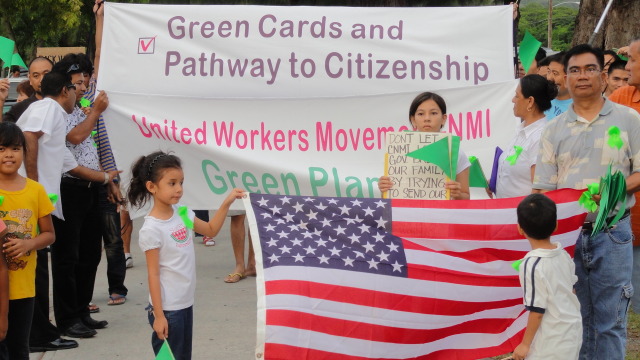
Perhaps the greatest irony is that nearly twenty years after federalization, many of the fundamental questions remain remarkably familiar. The Commonwealth still depends heavily upon foreign labor. Employers continue to report difficulty recruiting sufficient local workers in many industries. Local residents continue expressing understandable frustration over employment opportunities. Long-term foreign workers continue living under a legal status described as temporary despite having spent twenty, thirty, or even forty years building their lives here.
The names of the visa classifications have changed.
The agency administering them has changed.
The paperwork has changed.
But many of the underlying realities have not.
That observation should not be interpreted as an argument against federalization, nor as nostalgia for the old local immigration system. Rather, it serves as a reminder that immigration policy often behaves differently in practice than it does on paper. Laws may change overnight. Human systems rarely do.
It is also why legislation such as S. 5023 gives me pause, not because I question its stated objective, but because experience has taught me to ask a question that often receives too little attention during legislative debates.
How will this law function when it encounters circumstances that do not fit the scenario Congress had in mind?
Consider a hypothetical example.
Imagine a long-term CW worker who has spent the better part of two decades living in Saipan. She travels to the Philippines because her father has suffered a stroke. During her visit, she discovers she is pregnant. A few weeks later, she attempts to return to the Commonwealth, where her employment, her home, her friends, and the life she has spent years building all await her.
What distinguishes her, at first glance, from someone an immigration officer believes is entering the United States primarily to give birth?
Perhaps the distinction is obvious.
I hope it is.
Most immigration officers perform an extraordinarily difficult job with professionalism and integrity, often under circumstances that demand difficult decisions based upon incomplete information. My concern has never been that these men and women act in bad faith.
My concern is that no system requiring human judgment can ever eliminate the possibility of human error.
When those errors occur in immigration law, the consequences are seldom academic. A mistaken decision may separate families, interrupt careers, jeopardize legal status, or upend lives that have been patiently built over decades. Those realities are not unique to the Commonwealth, but the CNMI has perhaps experienced them more persistently than most.
That is precisely why I believe our islands have something meaningful to contribute to the national discussion surrounding birthright citizenship.
Too often, our debates begin with broad categories rather than individual circumstances. We speak of "birth tourists," "illegal immigrants," "guest workers," and "foreign labor" as though each phrase describes a single, easily identifiable group of people. Reality is almost never so accommodating. Human lives possess a stubborn habit of resisting the neat categories into which governments attempt to organize them.
The Commonwealth has spent decades reminding us of that truth.
Perhaps more importantly, it has reminded us that well-intentioned legislation can produce consequences no one anticipated. Not because lawmakers lacked intelligence or compassion, but because governing complex societies invariably involves variables that cannot be fully appreciated from committee hearings or legislative reports alone.
There is an old saying that experience is the best teacher. If that is true, then the Commonwealth has paid dearly for an education that the rest of the country has yet to receive. It would be unfortunate if those lessons remained confined to our islands precisely when the nation once again finds itself reconsidering the future of its immigration system.
Whether Congress ultimately passes S. 5023 is, in many respects, beside the point.
Another bill will eventually replace it.
Another administration will introduce another proposal.
Another Congress will promise another solution.
The particulars will change.
The underlying challenge will not.
How do we preserve the integrity of our immigration laws without losing sight of the human beings who must ultimately live under them?
That is not a new question.
The Commonwealth has been wrestling with it for decades.
Long before birth tourism became a national headline, our islands were already learning difficult lessons about the unintended consequences of immigration policy, the limits of even the best-intentioned legislation, and the profound impact that administrative decisions can have upon ordinary families simply trying to build a life. We witnessed the uncertainty surrounding the federal transition. We watched as the original transition period had to be extended repeatedly because reality proved far more complicated than policymakers had anticipated. People in the CNMI adapted to the creation of the CW-1 program, only to find themselves navigating years of changing regulations, shifting numerical caps, repeated renewals, mounting petition fees, and continuing uncertainty over what the next extension or policy revision might bring.
For many employers, each new filing represented another administrative burden. For many workers, it represented another several hundred dollars that had to be found somehow, another petition that had to be approved, another reminder that decades of lawful residence still translated into only temporary legal certainty. Thousands of families persevered through that uncertainty because they had little choice. Their lives, their livelihoods, and in many cases their children's futures, depended upon successfully navigating a system that seemed to reinvent itself every few years.
And yet, despite all of those years of transition, extensions, new visa classifications, and countless regulatory changes, many of the underlying realities remain remarkably familiar. The Commonwealth still depends heavily upon foreign labor. Employers still struggle to fill certain positions. Many local residents still voice understandable frustration over employment opportunities. Thousands of long-term foreign workers still find themselves living under a legal status officially described as temporary despite having spent twenty, thirty, or even forty years calling these islands home.
That history deserves to be remembered, not because it offers easy answers, but because it reminds us to approach every new immigration proposal with a measure of humility. Good intentions matter. Thoughtful legislation matters. But experience teaches us that the true test of any immigration policy is not simply whether it addresses the problem it was written to solve, but whether it also avoids creating new hardships for those who were never the intended target.
That, more than anything else, is why I wrote Shadows in Paradise.
I wanted to preserve the Commonwealth's immigration story before it faded from memory. I wanted future generations, both there and on the mainland, to understand that behind every visa category, every petition, every renewal, and every policy debate are real people whose lives cannot be neatly summarized by the labels we attach to them. More importantly, I hoped that by preserving our history, perhaps others might learn from it before repeating the same mistakes under different names.
If this latest debate over birthright citizenship encourages more people to look back at the Commonwealth's experience with fresh eyes, then perhaps Shadows in Paradise still has an important role to play. History is most valuable not when it tells us where we have been, but when it helps us think more carefully about where we are going.