Speech at the PCC Immigration Forum: The CNMI Foreign Worker Crisis (November 10, 2011)
Immigration, CNMI, Human Rights
Speech at the PCC Immigration Forum: The CNMI Foreign Worker Crisis (November 10, 2011)
By Kelvin Rodeo
Delivered at an Immigration Forum at Pasadena City College on November 10, 2011. This is the earliest known public speech by Kelvin Rodeo on the CNMI foreign worker crisis, bringing the issue to a mainland U.S. audience for the first time.
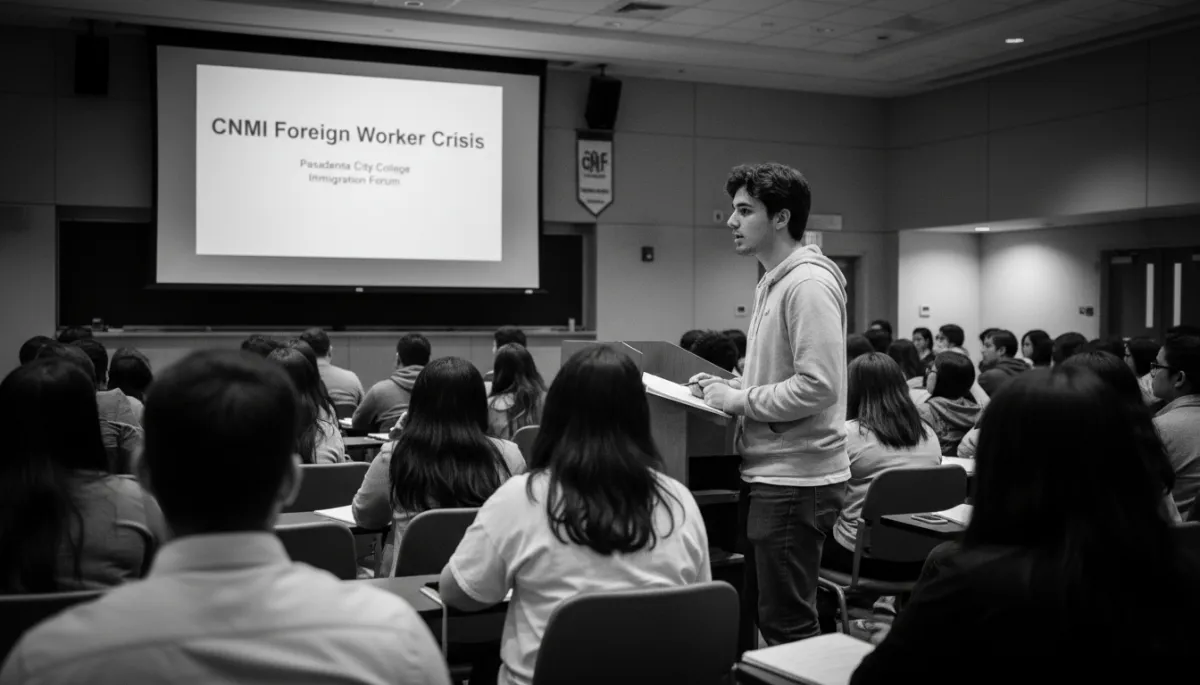
Thank you for allowing me to speak at this forum. My name is Kelvin Rodeo, and I'm a student here at PCC and a veteran of the United States Navy. I come from a tiny island in the Pacific called Saipan. It is the capital island of the United States Commonwealth of the Northern Mariana Islands. I have come before you today because there is a very important immigration issue happening on U.S. soil that the majority of the American people are unaware of, and I intend on shedding some light on that situation today.
I'd like to start off first by reading a letter to the editor published in the Marianas Variety, one of the local newspapers on Saipan, on November 4th, written by a high school junior named Kristine Valencia. Her letter says:
My life is going to change. Yes, I know — things change every day — but you like to think that you have some control over the decisions and that you can make most changes for the better. The ones that you don't have control over are usually accidents and disasters. Well, the changes coming into my life are outside of my control and I'm afraid that they might be disastrous — at least to my life-long dreams and plans.
I'm 16 and now into my junior year at Marianas High School. I was born here. I grew up here. All of my friends are here and all that I have learned and experienced happened here. My family is here; my four younger sisters and a younger brother, also all born and raised here, and my mother and father. We picnic on the beach, we swim in the lagoon, we enjoy the company of friends from a variety of ethnicities and cultures. This is home.
I am an American from Saipan. When people ask me my nationality, I say, "I'm an American." When they ask me where I'm from, I say, "From here, Saipan." My bloodline may be Filipino, as others here may be English, German, Chamorro or Spanish — and I am proud of it — but I am an American.
Of course, my mother and father weren't born here. They are both from the Philippines, and that appears to be the problem. They have been here 20 years now and my father has been employed every day of it, working hard, paying his taxes, driving within the speed limit, doing all of the things that a good citizen does — without being a citizen, of course. They have taught me and my siblings to be good citizens. Like me, they have enjoyed the beaches, the restaurants, the friendship of many people here, and the pleasure of a good community. Saipan is also their home. No, I guess I can't say that, can I? Saipan has been their residence for 20 years, but it clearly cannot be their home.
My father's employer wants him to stay and is going through the process. So maybe his employment will be continued, maybe not. His company values his presence and has done its part. It's now up to the USCIS. If his petition is not approved, he will have no choice but to leave his "residence" and return to his "home." If this happens, I will probably "go" with him — not "return to MY home," though. Regardless of how proud I might be of my heritage, the three weeks that I have visited there out of my 16 years does not make it my home. My home is here, even though it seems as if we are not welcome to remain.
This is not being written for sympathy. I guess it's written more out of anger that this is happening to me, my family and all of the other kids and families in similar situations, in compliance with the laws of the United States. The United States that I and my brother and sisters, and all of the other US-citizen-kids, are citizens of; the United States that supposedly guarantees us the privileges and immunities of citizenship, protection from being deprived of our life, liberty, or property, and promises that we will not be denied the equal protection of the laws.
I'm obviously not a lawyer and I'm sure one would tell me that none of this really applies to our situation. All that I can say is, if all of these privileges, rights and protections don't apply, then something is wrong. They should.
I write out of anger — yes, but I am also writing out of my disappointment. This is not a situation that could not have been anticipated. Both my birth-community and my government knew that my brother and sisters and I and all of the other U.S. citizen children with non-U.S. citizen parents were here. Why wasn't it anticipated?
This isn't a case of someone flying in or crossing the border to have a U.S. citizen baby. Our parents were invited here, legally, to work for the benefit of the community, which they did. They provided skills and services that the community needed and could not fill internally. They provided these services, not in temporary positions for short periods, but in permanent jobs, as the USCIS is now identifying the positions for CW-1 visas. If this had occurred in the mainland U.S., an avenue to citizenship would have been available. Why were our parents used, ignored, and now discarded?
And we were born here, U.S. citizens, growing up as American kids, going to American schools, speaking American English, dreaming the same dreams as other American kids and making the same plans as other American kids. Up until now — now our lives are going to change and those dreams may die and those plans may never have a chance to come to life.
It appears that many of us will have two choices to make — or rather, our parents will — as we are still just children, U.S. citizen children. One possibility is that we leave — leave our friends, our community, our home — and, in my case, go to live in a small town in Bulacan province, outside of Manila. I will restart my junior year in school, at an age when most Filipino kids have already graduated. I will graduate in two years as an American kid with a non-U.S. high school diploma, hoping to somehow gain acceptance to a U.S. college with my non-U.S. diploma, with little hope for the scholarships that I could have received here. The consequences of this option will be similar for all of the other U.S. citizen kids.
The other choice is that my parents find a guardian for me here and I stay and complete high school here, hopefully gain acceptance to a college in the mainland or start with our college. The cost of this choice is that I spend those next two years without my brother, sisters, and parents. I love my family and would be miserable without them. Will my country look out for me in their place? Why is my country doing this to us? Why wasn't this anticipated? Again, this isn't a sudden situation that just popped up out of nowhere. Something could have and should have been done earlier.
Don't misunderstand me. I recognize and appreciate Congressman Sablan's ongoing efforts, but that overused phrase fits this perfectly — it's too little too late. Why aren't our community leaders concerned and fighting for our futures? Why isn't our President and our country concerned? Concern is shown over whether a U.S. citizen terrorist has rights, but no one seems concerned over whether thousands of innocent U.S. citizen children have rights. No concern is shown that the United States will lose the potential of thousands of U.S. citizen children as they are forced to leave their country over the next few years.
But we do have rights, don't we? Yes, we have the right to make a choice — our dreams or our family? Which should I choose? Which would you choose? Why are we being forced to make such a choice?
Yes — my life is going to change.
That was the end of her letter.
H.R. 1466 and the Question of Who Gets to Stay
The Congressman that she is referring to, Congressman Sablan, is the CNMI's first nonvoting delegate to the United States Congress. He has introduced H.R. 1466 into Congress, which would allow persons born in the Northern Marianas between 1974 and 1978, persons given permanent resident status under CNMI law, and their family members to continue to live and work in the Marianas. The bill also permits immediate family members of U.S. citizens to remain in the Marianas until they can adjust their status under U.S. immigration law. Only persons who entered the Northern Marianas legally and remain legally present qualify under the bill. No amnesty is provided to anyone who does not have legal status.
What and Where Is the CNMI?
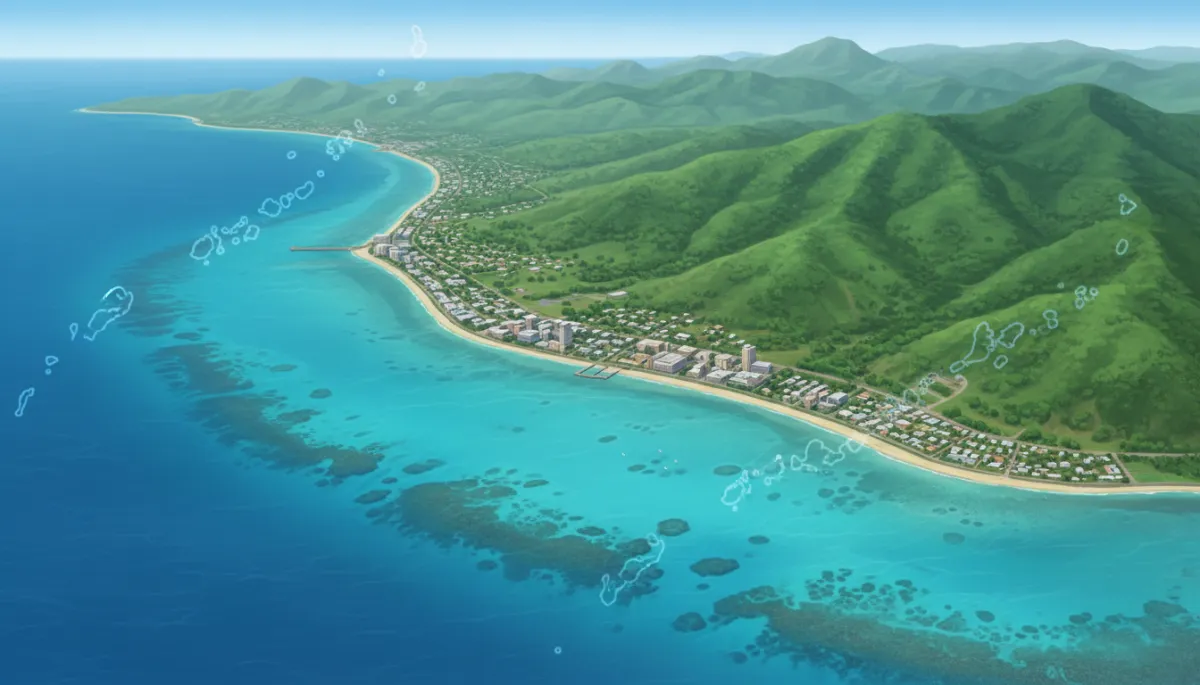
A lot of you might be wondering, "How does this apply to us? What exactly is the 'CNMI'?" To create the link, I'll have to briefly go over the history of the Islands' ownership, and then lay the groundwork for how this all ties in to immigration issues in the United States.
The Commonwealth of the Northern Mariana Islands is a group of islands in the Pacific that were first "discovered" by Magellan in 1521. He claimed the islands for Spain and they were later named the Marianas. The islands were then sold to Germany in 1899 and remained under the German flag until 1914, when the Japanese took the islands from the Germans in World War I. The islands were administered by the Empire of Japan until June 1944, when American forces invaded and captured the islands in World War II.
After the war ended, the islands were in limbo until July 1947 when the United Nations recognized them as being part of the Trust Territory of the Pacific Islands, to be administered by the United States Navy and later the Department of the Interior. In June 1975, the people of the Northern Marianas voted in a plebiscite to become a part of the American family, and in January 1978, the Northern Mariana Islands became a self-governing Commonwealth in political union with the United States. On November 4, 1986, qualifying residents became U.S. citizens. The islands have since then been known as the United States Commonwealth of the Northern Mariana Islands.
The CNMI Guest Worker System and Labor Abuses
In talking about labor and immigration issues in the CNMI, it is important to note that the Islands are indeed U.S. soil. As part of its agreement to become a U.S. commonwealth, the CNMI was bound by many U.S. laws, but was exempt from many U.S. labor and immigration laws. In 1983, the CNMI established its own immigration laws, including a guest worker statute called the Nonresident Workers Act. The Nonresident Workers Act set out procedures by which guest workers could be hired. It required employers to give guest workers one-year contracts and to specify their job titles and duties, which may not be altered. The Act also allowed guest workers to change jobs.
In 2007, the CNMI government passed a new statute which enacted many new restrictions on guest workers, including no longer allowing them to change employers. The statute's "Legislative Findings" section attempts to justify the restriction as necessary to protect the natives of the islands from competition from guest workers, as noted in the following:
Wage rates will not rise so long as cheap foreign labor is available. The incentives to foreign workers to remain in the Commonwealth are very large because working conditions in the Commonwealth are so far superior to the working conditions in their home countries. For that reason, foreign workers will always accept lower wages than citizens and permanent residents. It was never the purpose of the legislative enactments with respect to the use of foreign labor in the Commonwealth to perpetuate jobs at the minimum wage rate. If that happens, much of the Commonwealth's investment in secondary and post-secondary education for its citizens will be lost as those citizens migrate outside the Commonwealth to find good-paying jobs. The current economic situation in the Commonwealth requires the continued availability of foreign nationals to augment the work force in the Commonwealth but also demands that the system for regulating the employment of foreign nationals be more efficient and less costly to operate.
Guest workers in the CNMI were supposed to provide only a temporary fix for labor shortages, but the majority of them were renewed each year, which resulted in them staying indefinitely. Former CNMI Governor Froilan Tenorio speculated that a reduction of the CNMI's guest worker population would spell the demise of the islands' businesses, and this was the stance taken by many employers in the islands. For many years, the foreign workers did the jobs that local residents would not do, such as work in the garment factories, on farms, and as household live-in maids. Many foreign workers ended up working in the CNMI for 5, 10, 15, and some even over 20 years.
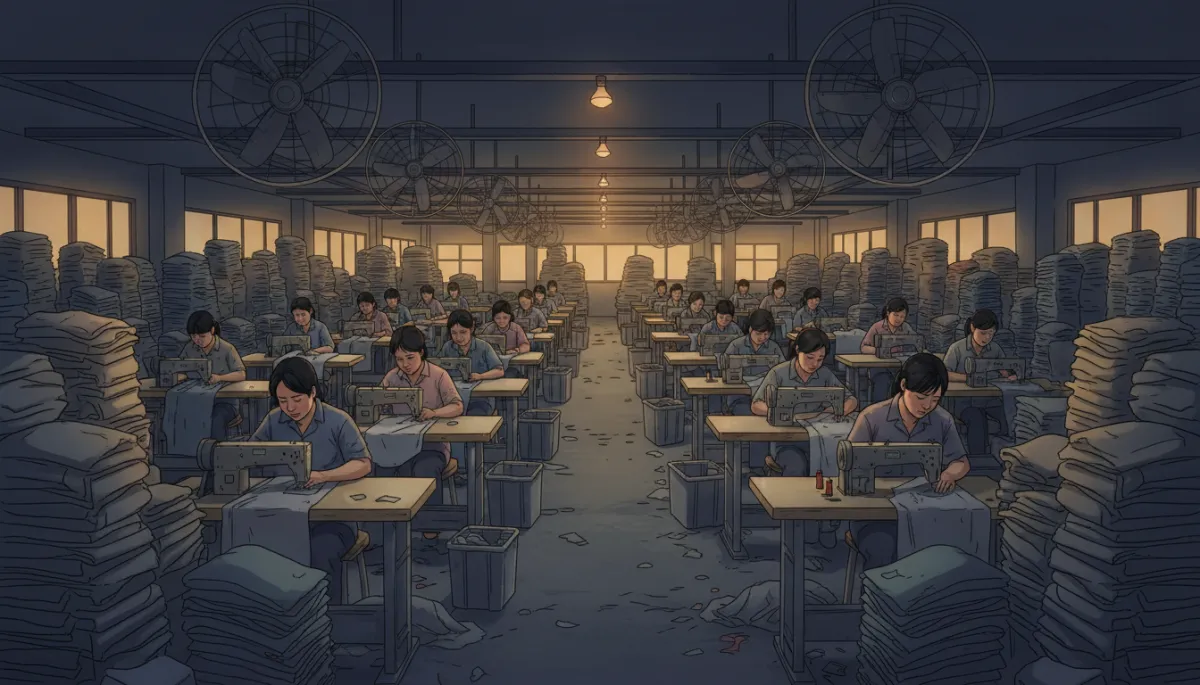
Among all of the sectors employing foreign labor, the garment industry attracted the most media attention for abuse of its mostly female Asian workforce. Up until garment factories on Saipan started shutting down in 2005, the garment industry was one of its largest recruiters of nonresident workers. The garment industry forced its foreign employees to do overtime, and sometimes regular work, without pay, provided them with unhealthy and dangerous work and living environments, and gave them few, if any, days off. Blocked exits, un-air-conditioned buildings, several food poisonings — one of which was the largest workplace food poisoning case found by the Occupational Safety and Health Administration (OSHA) — inaccessible clean running water, machines without safety guards, and broken toilets exemplified the factories' flagrant abuse of federal health and safety regulations.
In addition to that, the minimum wage in the CNMI at the time was a measly $3.05 an hour, and that's assuming that the garment workers even got paid. All of this is important to note because many big companies such as Gap, Old Navy, J. Crew, Banana Republic, J.C. Penney, Ralph Lauren, and Liz Claiborne had their products manufactured on Saipan. Its status as a U.S. territory allowed it to apply the label "Made in the USA" to any goods manufactured there.
From Local Control to Federalization: The CNRA and CW Visas
In the early 1990s, the situation was made known to various members of the United States Congress and they responded by introducing bills that would extend the protection of U.S. minimum wage labor laws to the CNMI. However, the CNMI government, upon hearing about this, hired lobbyists in hopes of preventing the passage of any bills that would remove the CNMI's exemptions from U.S. immigration and labor laws.
In 2008, when the majority of Congress consisted of Democrats, Public Law 110-229, the Consolidated Natural Resources Act of 2008, or CNRA, was passed, and provisions within the Act extended federal labor and immigration laws to the CNMI. Tens of thousands of long-time foreign workers in the CNMI cheered as they perceived this to be a great victory — however, they were unaware of the bigger nightmare that was to come as a result of federalization.
As part of the implementation of the CNRA, U.S. Citizenship and Immigration Services established a Transitional Worker Program which established a new visa classification. The Transitional Worker Visa category is a new nonimmigrant visa classification under the Immigration and Nationality Act, or the INA, using the admission code CW-1 for the principal transitional worker and CW-2 for dependents. The transition period began on November 28, 2009 and will end on December 31, 2014. The CW classification is valid for the duration of the transition period. At the end of the transition period, the CNMI-Only Transitional Worker Program will cease to exist and the transitional workers who held this status must change to another nonimmigrant or immigrant status under the INA to stay in the CNMI lawfully.
The CW visa classification is valid only in the CNMI and provides no basis for travel to any other part of the United States, including the neighboring island of Guam. Once status is obtained, the CW-1 or CW-2 nonimmigrant may leave the CNMI and return, but must have the appropriate visa for readmission.
Long-Term Workers, Limited Relief, and H.R. 1466
The problem with this is that no consideration is given to improve the status of those long-term foreign workers who have spent years, some even decades, developing the CNMI into what it is today. Those individuals, should they qualify for this new status, will, after their many years of service to the CNMI, and effectively, the United States, still be considered nonresident workers.
Enter CNMI Congressman Gregorio Sablan, who introduced H.R. 1466 as his answer to this particular problem. The part of the bill that deals with the long-term foreign workers is the part that says that the "bill also permits immediate family members of U.S. citizens to remain in the Marianas until they can adjust their status under U.S. immigration law." It is estimated that there are currently about 16,000 legal, long-term foreign workers in the CNMI, but only about 4,000 of them have a U.S. citizen spouse or child, which makes them immediate relatives of U.S. citizens and therefore covered by the bill. No support has been shown for the other 12,000 human beings who have been living and working in the CNMI for an extended period of time but do not have a U.S. citizen spouse or child. That is only the first of many flaws relating to H.R. 1466.
📌 Key Takeaway: Even reform proposals like H.R. 1466 left most long-term foreign workers in the CNMI without a viable path to secure status.
Wendy Doromal’s Critique: Parallels to Black Codes
In her blog, Unheard No More!, human rights activist Wendy Doromal says of H.R. 1466:
The similarities between laws that were implemented after the Civil War and H.R. 1466 are striking. H.R. 1466 proposes to grant about 1/4 of the 16,000 legal, long-term nonresident workers a CNMI-only status. No other state or territory has their own status under the INA, and for good reason. The long-term foreign workers of the CNMI have been considered as labor units for decades. Under H.R. 1466 they will remain as a disenfranchised underclass, as labor units chained to the CNMI. The discriminatory status would restrict travel and deny them of political, social and economic rights just as the post-Civil War Black Codes kept the freed slaves as second-class citizens unable to serve on juries, vote or hold public office. Under the Black Codes, some states forbid social mobility, prohibiting freed slaves from entering certain states. Similarly H.R. 1466 would prohibit the "freed" nonresident workers from entering the United States or leaving the CNMI.
The Black Codes were rooted in pre-Civil War slave laws, just like H.R. 1466 is rooted in the old CNMI labor and immigration system, which aimed to keep nonresident workers denied of political, social and economic rights. Under the Slave Codes, Black Codes, CNMI P.L. 17-1 and H.R. 1466 people are viewed as labor units, instruments or tools to fuel the economy, rather than as human beings deserving of human and civil rights. Usually democratic societies advance forward, but H.R. 1466 takes us back to a shameful time in our country's history when segregation and discrimination were legal.
Wage Theft, Fear, and the Cost of Speaking Out
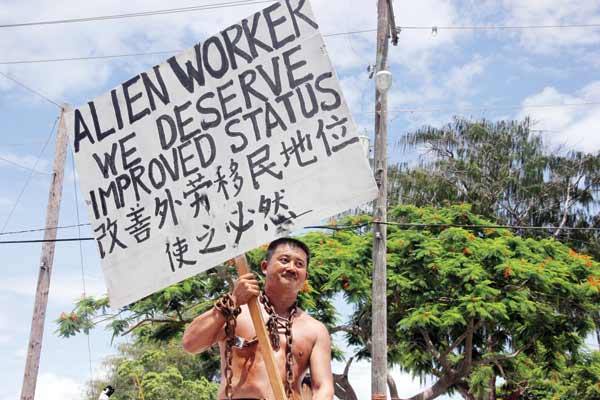
Most of the legally employed long-term foreign workers in the CNMI have been victims of wage theft. In 2008, there was $6.1 million in uncollected judgments documented, and the amount has only increased since then. Now, even as they face removal from the CNMI or deportation as their lawful status expires on the 27th of this month, they are still waiting to get paid what is owed to them.
Most of them have had to put up with these kinds of abuses by their employers because if they ever complained about any of the injustices being committed against them, their employer could send them back to their country of origin by not renewing their contract. For many of them, this was simply not an option, as they had built families in the long time that they had been living in the CNMI, and they did not want to leave their children behind, nor did they want to strip them of their rights as U.S. citizens if they were to bring them along to live in their country of origin.
And so, the foreign workers endured everything that was thrown at them, all for the sake of keeping their families together. When paychecks were delayed, they made no complaints. When wages were stolen from them, they simply winced and kept on working. They took it all and never complained to anyone of importance about what they were suffering through, for fear of being sent away.
“Go Home” Graffiti and Rising Racism
And now, after 5, 10, 15, 20 or more years of living in the CNMI, building the roads, the schools, the commercial buildings, taking care of the local residents' children, supporting the tourism industry by cleaning the hotel rooms, working in the restaurants, and working the reception areas, now, after being the backbone of the CNMI all this time, the foreign workers, both those with and without families, face losing their legal status and ultimately face removal from the islands without even so much as a "Thank You" from the CNMI government.
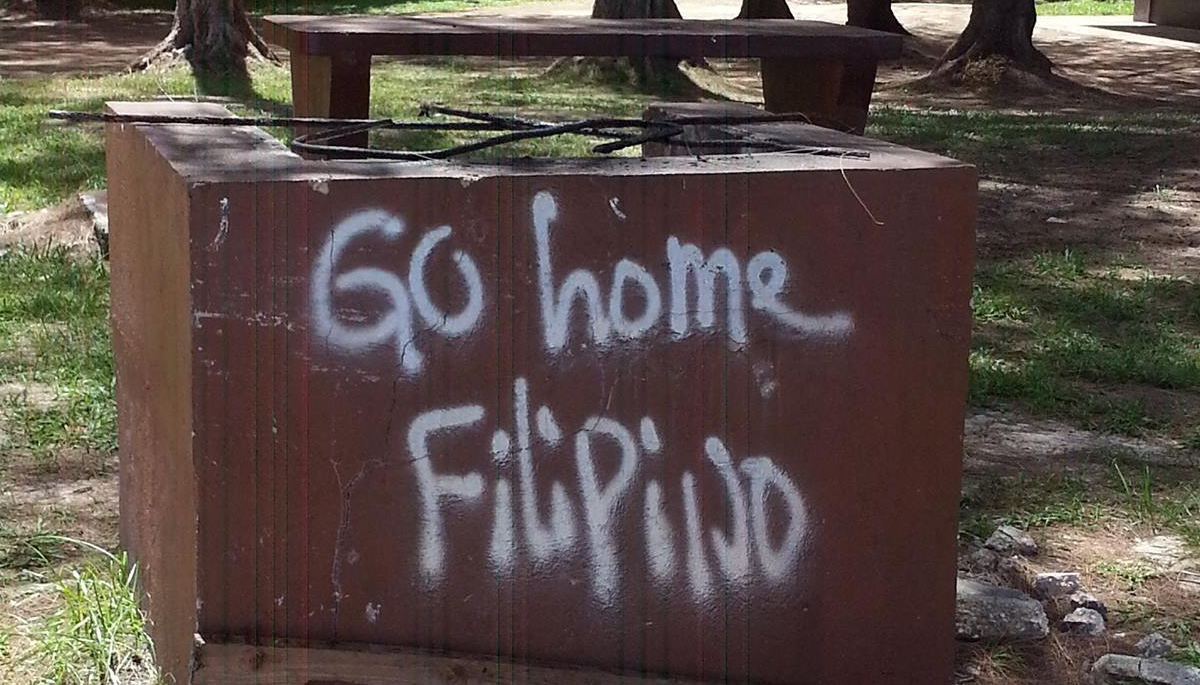
Furthermore, instead of feeling gratitude towards these hard workers, many of the local citizens feel resentment towards them, claiming that they took their jobs from them and that they should just go back home, not realizing that to these thousands of workers who have been in the CNMI for so long, the islands ARE their home now.
As the deadline of November 27 draws near, more and more racism is evident among the local population, with graffiti being sprayed on buildings all over Saipan consisting of messages such as "Go home alien P.I.," with "P.I." referring to the Philippines, one of the many countries that these foreign workers came from, "0 status go home Filipino," "Stupid alien Syed terrorist," Syed being the name of the president of the United Workers Movement, and "Go home Filipino illegal fraud terrorists."
Families at a Crossroads: U.S. Citizen Children and Impossible Choices
With everything that these de facto residents of the CNMI have had to put up with over the years, I really must admire them for their strong resolve. Sadly, they are losing hope as the deadline draws closer, and many have already left the islands, taking with them their U.S. citizen children to their countries of origin.
Unless something is done to help them gain improved status, many of those who remain in the CNMI have a choice, as Kristine Valencia explained in her letter, to uproot their kids, taking them away from the only home they've ever known, away from all their friends, to live in a foreign land where most of them don't even understand the language, OR they can choose to leave their kids behind in the care of a trusted friend or relative who is a citizen and is willing to assume legal guardianship over the children.
⚠️ Warning: Families are being forced into a choice no one should face — separate from their children or exile them from their own country.
But why should anyone have to make that kind of choice? Why is Congress turning a blind eye to these thousands of people who have been living and working on U.S. soil for such a long time? As the nationwide immigration debate heats up here in the continental United States, most Americans don't even realize that there's another huge problem occurring on U.S. soil, just 6,000 miles across the Pacific.
It is my fervent hope that something will be done to help these people soon, so that kids like Kristine Valencia won't have to be subjected to that kind of decision.
Thank you for your time.