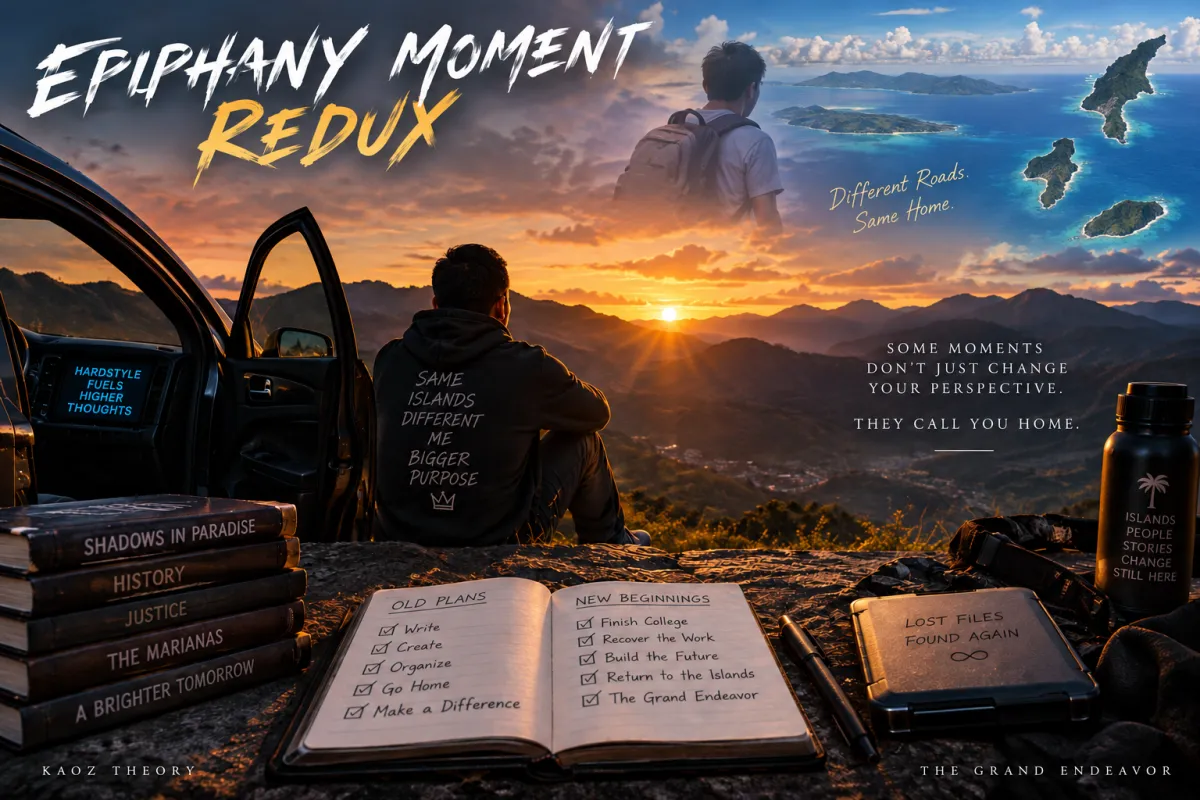
Epiphany Moment Redux
EPIPHANY MOMENT REDUX
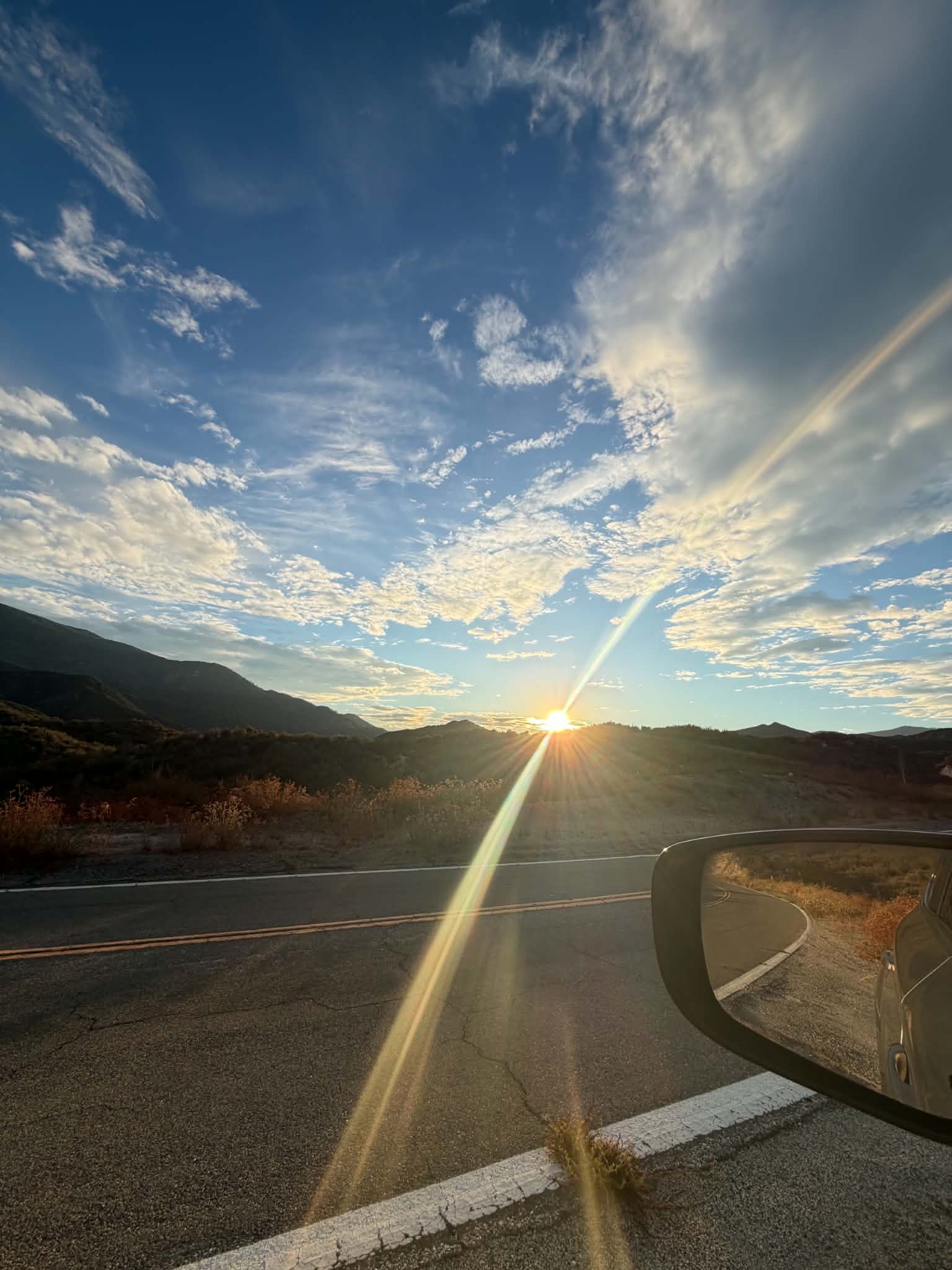
Upper Big Tujunga Canyon
September 7, 2026
I went into the mountains
to get away from everything.
Instead,
everything found me.
Labor Day.
Upper Big Tujunga Canyon.
The sun was beginning its slow surrender
behind the mountains,
pouring gold through the valleys,
stretching shadows across ridgelines
older than every problem
I had carried up there with me.
Hardstyle thundered through the speakers.
Kick drum.
Melody.
Kick drum.
Sky.
And somewhere between the bass
and the dying light,
I broke.
Not sadness exactly.
Something bigger.
The kind of crying that happens
when beauty becomes unbearable
because, for one impossible second,
you can see your entire life
from somewhere outside of it.
And the Universe asked me a question.
Or maybe I asked it.
Or maybe I had been avoiding it
for fifteen years.
What happened to you?
Because once,
there was a kid thousands of miles from Saipan
who believed he could help change the Marianas.
A firecracker.
A radical little upstart.
Unwavering.
Obnoxiously hopeful.
Writing.
Organizing.
Fighting.
Demanding justice
for people our islands depended upon
while still calling them temporary.
He believed history was something
ordinary people could grab
with both hands
and bend.
And somewhere along the way,
I lost him.
Life happened.
Years happened.
Survival happened.
The fire became an ember,
then something I occasionally remembered
when digging through the ruins
of who I used to be.
So I sat there in my car
beneath those enormous mountains
and cried for him.
For the person I had been.
For the years between us.
For the plans I wrote
for islands thousands of miles away
because distance had somehow never convinced me
they weren’t home.
And then another question came:
Where is our generation?
How many of us left home
believing we would return someday?
How many became adults elsewhere?
Built careers elsewhere?
Built lives elsewhere?
How many kept saying
one day
until one day became
ten years?
Fifteen?
Twenty?
And why, after all this time,
does change still feel like something
the Marianas keeps promising itself
in the future tense?
I stared through the windshield.
Mountains.
Sunset.
Bass rattling the car.
Tears running down my face.
And suddenly the answer that terrified me most
was also the simplest:
Go home.
Not tomorrow.
Not recklessly.
Not without preparation.
But begin.
Begin becoming the person
who can return.
Which apparently means
I have to go back to college.
Because society has constructed
this magnificent little ritual
where I must spend thousands of dollars
and several years of my life
earning a rectangular piece of paper
before certain people will decide
that the thoughts inside my skull
have become sufficiently legitimate.
Fine.
Give me the paper.
I have work to do.
Because something strange
has been happening lately.
Something I almost don’t trust yet.
The fire is coming back.
I wrote a book.
Then somehow
I became a published author.
Then a bestselling one.
And suddenly words started pouring out of me again.
Stories.
Games.
Music.
Worlds.
Ideas I thought I had buried.
And then, almost absurdly,
the dead hard drive came back.
The one that had failed years ago.
The one I thought had swallowed
my old writing,
my old music,
my unfinished projects,
little fossils
from another version of myself.
Suddenly,
there they were.
Alive.
Waiting.
And maybe that is coincidence.
Maybe resurrection sometimes arrives
wearing the extremely unromantic disguise
of successful data recovery.
But sitting beneath those mountains,
I couldn’t shake the symbolism.
Because perhaps
the hard drive wasn’t the only thing
coming back online.
Perhaps I am recovering files
from myself.
Fragments of an old operating system.
Blueprints.
Dreams.
Promises.
Coordinates
to somewhere I once intended to go.
And every strange creative thing
I have made lately
seems to point toward the same tiny chain of islands
in the Pacific.
The book points home.
The stories point home.
The games point home.
The history points home.
Even the future I keep imagining
points home.
Marianas.
Marianas.
Marianas.
As though my entire creative life
has become a compass
whose needle refuses to point anywhere else.
So maybe this is the beginning.
Not of some grand prophecy.
Not proof that the Universe
has appointed me anything.
Just the terrifying recognition
that there is work I believe
I am supposed to attempt,
and that continuing to avoid it
would require me to betray
something fundamental in myself.
Audacious?
Absolutely.
But these are audacious times.
And I would rather spend my life
attempting something enormous
than grow old knowing
I heard the islands calling me home
and chose not to answer.
So I am going back to school.
I am recovering the old plans.
I am finishing the abandoned projects.
I am rebuilding the machinery.
I am studying the past
while designing futures.
I am preparing myself
for the long road home.
Because the firecracker kid
I thought I had lost
wasn’t dead.
He was waiting.
And on September 7, 2026,
somewhere in Upper Big Tujunga Canyon,
with the sun disappearing behind the mountains
and hardstyle pounding through my speakers,
I found him again.
Or perhaps
he found me.
And this time,
I intend to see
where he was trying to take me.
The Grand Endeavor begins here.
The Story Behind “Epiphany Moment Redux”: When the Islands Called Me Home
On September 7, 2026, I went hiking in the mountains and somehow came back down having decided that I needed to reorganize the trajectory of my life.
So that was inconvenient.
It was Labor Day, and I had driven up into Upper Big Tujunga Canyon for what was supposed to be a nice, relaxing hike. There was no spiritual pilgrimage planned, no intention of interrogating the direction of my life, and certainly no expectation that I would emerge from the mountains contemplating destiny, the Marianas, college, my younger self, and the increasingly suspicious timing of several things that have happened to me this year. I wanted mountains, fresh air, solitude, and an irresponsible amount of hardstyle.
After the hike, I got back into my car as the sun was beginning to descend toward the horizon. The mountains and valleys around me were covered in that strange golden light that appears for only a few minutes before sunset, with long shadows stretching across the landscape and making everything look impossibly vast. Hardstyle was playing through my speakers, the melodies soaring over those enormous pounding kicks, and for whatever reason, the combination of the music and the landscape completely overwhelmed me.
I started crying.
Not because I was sad, exactly. It was something much harder to explain. The beauty of everything suddenly felt unbearable, as though my brain had briefly lost whatever filter normally prevents us from being emotionally obliterated by the fact that the world is astonishingly beautiful sometimes. I sat there staring through my windshield, bawling my eyes out while hardstyle rattled the car, and a flood of emotions, memories, frustrations, ambitions, and questions that I apparently had been storing somewhere inside myself decided that this was their opportunity to arrive all at once.
Somewhere in that flood, one question rose above everything else:
What happened to me?
The person I used to be
There was a version of me, many years ago, who genuinely believed that he was going to help change the Marianas.
He was younger, angrier, more idealistic, and probably significantly more annoying. 😂 But he was also unwavering in a way that I haven't been for a very long time. From thousands of miles away, I spent years thinking about the future of the islands where I grew up and advocating for justice for the foreign workers of the CNMI. I wrote constantly. I argued constantly. I organized. I imagined reforms. I wrote plans for what I believed the Marianas could become.
Most importantly, I believed that history was something ordinary people could actually interfere with. It wasn't an enormous machine operating somewhere above us while the rest of us simply endured whatever came out the other side. People made history, which meant people could grab hold of it and bend it in another direction.
Then life happened.
There wasn't one dramatic moment when I simply abandoned that person or decided that those things no longer mattered to me. Years simply accumulated. Work happened. Adulthood happened. Survival happened. Other interests and ambitions appeared, and eventually the person who had once been so relentlessly focused on the future of the Marianas became someone I mostly encountered when I stumbled across an old piece of writing or remembered something I had once planned to do.
The fire didn't completely disappear, but it became an ember.
Sitting beneath those mountains that afternoon, I suddenly became painfully aware of how much I missed him. I cried for the person I had been, for the years between us, and for all those plans I had written for a tiny chain of islands thousands of miles away because, somehow, distance had never managed to convince me that they weren't still home.
And once that door opened, another question came through it.
Where is our generation?
I started thinking about how many people from my generation grew up in the Marianas and eventually left. We went away to college. We joined the military. We found jobs elsewhere. We built careers, relationships, families, and entire adult lives thousands of miles from the place where many of us first imagined our futures.
I imagine that plenty of us once thought we would eventually return.
The problem is that eventually is an extraordinarily elastic word.
You leave thinking you'll come back someday, and then someday becomes five years. Five becomes ten. Ten becomes fifteen. Suddenly you realize that an entire generation of people who grew up on the islands has been becoming middle-aged somewhere else.
That thought collided with something else that had been bothering me: after all these years, why does meaningful change in the Marianas still so often feel like something perpetually waiting in the future? Every election cycle brings another conversation about change, another collection of frustrations about the direction of the islands, another promise that things can be different. Yet so much continues to feel familiar.
For years, it was easy for me to look homeward from thousands of miles away and ask why somebody wasn't doing something.
Sitting in that car, the question turned around and looked back at me.
What exactly are you waiting for?
That was much less comfortable.
Because once you ask yourself that question sincerely, you lose the luxury of imagining that responsibility always belongs to somebody else.
The answer I didn't particularly want
What formed in my mind that afternoon was remarkably simple:
Go home.
I don't mean that I received some divine instruction to immediately quit my job, buy a plane ticket, land on Saipan, climb onto a latte stone, and announce that the Universe had sent me. 😂 I am attempting to maintain at least a loose working relationship with reality.
What I mean is that returning home stopped feeling like a vague possibility assigned to some hypothetical future version of myself and started feeling like a direction. Not tomorrow. Not recklessly. Not without preparation. But if I genuinely believe that there is work I want to do in the Marianas someday, then I need to begin becoming the person capable of doing it.
Unfortunately, this revelation appears to involve college.
I hate school.
I have always struggled with the idea that knowledge becomes more legitimate because somebody paid thousands of dollars to acquire it inside designated rooms at designated times. We live in an era where an astonishing amount of humanity's accumulated knowledge is accessible through the internet. I can voluntarily disappear into some obscure historical rabbit hole for six hours, emerge knowing far more than any reasonable person ever needed to know about the subject, and have the time of my life doing it. Tell me that the exact same information is worth three college credits, however, and suddenly my brain files a formal complaint with management.
Nevertheless, institutions matter. Credentials matter. Perception matters. Whether I personally like that fact does not make it disappear.
If I am serious about eventually returning home and participating more meaningfully in the civic life of the Marianas, then I also have to be serious about preparing myself for that future. That means picking up where I left off in college and finally earning my bachelor's degree, partly because there are things I still need to learn and partly because, yes, society will inevitably assign greater legitimacy to my ideas once I possess the stupid rectangular piece of paper proving that I spent thousands of dollars acquiring them.
Fine.
Give me the paper. I have work to do.
Something has been coming back
Part of the reason this moment affected me so profoundly is that it did not happen in isolation. For several months now, something has been changing in my life, and I haven't quite known what to call it.
Earlier this year, I published my first book, Shadows in Paradise: The Dark History of the CNMI Guest Worker Program. Somehow, that book went from being another enormous creative project living inside my computer to an actual published work with my name on it, and then, unexpectedly, to becoming a #1 bestseller.
Something about that experience woke me up.
My creative drive came roaring back in a way I hadn't experienced for years. I wanted to write again. I wanted to make music again. I started developing games, stories, fictional worlds, historical projects, and ideas that had either been dormant for years or had seemingly appeared out of nowhere. It felt less like discovering a new version of myself than suddenly regaining access to rooms inside my own mind that had been locked for a very long time.
Then something almost comically appropriate happened.
An old hard drive of mine was restored.
This hard drive had failed years ago, and I believed I had lost everything on it: old writing, music projects, plans, fragments of unfinished ideas, and artifacts from an earlier period of my creative life. For years, I had assumed those things were simply gone forever.
And suddenly there they were again.
I am fully aware that there is a perfectly ordinary technical explanation for recovering data from a broken hard drive. I am not suggesting that God personally descended from Heaven and performed divine disk repair.
But symbolism has never been particularly interested in technical explanations.
Because while I was recovering files from that hard drive, something else had begun happening at almost exactly the same time.
I was recovering files from myself.
The dead hard drive wasn't the only thing coming back online
That idea eventually became one of the central metaphors in Epiphany Moment Redux. The more I thought about it, the more eerily appropriate it felt.
Old writing was returning. Old music was returning. Old plans were returning. Projects I thought were dead were suddenly sitting in front of me again, waiting to be finished.
And so was the person who had created them.
The younger version of me who believed he could build things, who believed ideas mattered, who spent an unreasonable amount of time thinking about the future of a tiny chain of islands in the Pacific, hadn't actually disappeared. Maybe he had simply gone offline for a while.
Then I began looking at everything I had been creating lately, and I noticed another pattern.
It all kept pointing in the same direction.
My book is about the Marianas. My historical work keeps bringing me back to the Marianas. The games I have been building increasingly revolve around the Marianas. My fiction keeps returning there. Even when I imagine futures that don't exist yet, I keep building them on those islands.
These projects might look wildly disconnected from the outside. A nonfiction book about labor history, a card game about the Marianas, speculative fiction, music, historical research, other strange little worlds rattling around inside my head. But underneath them, I started recognizing the same gravitational center.
Home.
It began to feel as though my creative life had quietly become a compass, and no matter how many times I spun it around, the needle kept settling in the same direction.
Across the Pacific.
Toward the Marianas.
Maybe destiny is too big a word
This is the part that becomes difficult to explain without sounding spectacularly self-important.
I genuinely believe that there are moments in life when disparate things suddenly align in a way that feels meaningful. Whether that meaning comes from God, the Universe, coincidence, subconscious pattern recognition, or the very human tendency to construct constellations from scattered points of light is something I can't prove and don't particularly feel the need to.
Maybe restoring the hard drive was just restoring a hard drive.
Maybe publishing the book simply reminded me how much I love creating.
Maybe the sunset was particularly beautiful that afternoon, the hardstyle hit exactly the right emotional frequency, and my nervous system decided that 5:00-ish in the mountains was an excellent time to unload fifteen years of unresolved existential questions.
All of that could be true.
But it doesn't change what I experienced.
Sitting in that car, I felt with startling clarity that I had spent long enough wandering away from something fundamental to who I am. I felt that this creative resurgence wasn't merely about making things again. Somehow, all of these projects were reconnecting me to the place where my story began, and forcing me to think seriously about what relationship I want to have with that place during the rest of my life.
I don't know whether I would call that destiny.
But I do know that I heard something.
And I would rather spend my life attempting something enormous than grow old knowing that I heard the islands calling me home and chose not to answer.
The Grand Endeavor
That is ultimately what Epiphany Moment Redux is about.
It isn't really a poem about mountains, although the mountains are where it happened. It isn't really about a hard drive, although that hard drive gave me the metaphor I needed to understand what had been happening inside me. And it isn't a declaration that I know exactly what my future holds, because I absolutely do not.
It is about recovering something you thought you had lost and discovering that an abandoned dream may not actually be dead. It is about realizing how dangerous the word someday can become when you allow it to quietly absorb years of your life. Most of all, it is about that deeply uncomfortable moment when the question changes from What happened to the person I used to be? into something much harder:
What am I going to do now that I've found him again?
I don't have a complete answer yet. There is school to finish. There are old plans to recover and entirely new ones that need to be written. There are unfinished creative projects sitting on my hard drive that deserve to finally exist outside of it. There is an enormous amount I still need to learn, and there is an entire life here that cannot and should not simply be dismantled overnight.
And somewhere across the Pacific, there is home.
For the first time in a very long time, those things don't feel like disconnected pieces of my life. The writing, the history, the games, the old files, the education I still need to finish, the younger version of myself I thought I had lost, and this persistent desire to eventually return to the islands all seem to be converging into the same story.
Maybe September 7, 2026 will turn out to have been nothing more than an unusually emotional afternoon in the mountains accompanied by some exceptionally well-timed hardstyle.
Or maybe, years from now, I'll look back on that afternoon and recognize it as the moment when the trajectory changed.
There is no way for me to know that yet. That's the strange thing about turning points: they don't arrive with historical markers already installed. You can only recognize them later by what you chose to do afterward.
So now comes the part that actually matters: doing the work. Going back to school. Recovering the plans. Finishing the projects. Learning. Preparing. Rebuilding the machinery of a version of myself I thought I had lost, while figuring out what the older version of that person is actually capable of becoming.
And beginning, finally, the long road home.
The Grand Endeavor begins here.