CNMI Covenant: A Unique Path to Commonwealth
History, CNMI Covenant, Commonwealth Status, U.S. Relations
How the CNMI Chose a Different Future: The Story of the Covenant and Commonwealth Status
On a humid evening in Saipan in the mid-1970s, elders and young leaders gathered under tin roofs and breadfruit trees, arguing gently but passionately about a single question: what kind of future should the Northern Mariana Islands choose? The answer they gave the world would be written into the CNMI Covenant to Establish a Commonwealth in Political Union with the United States, Public Law 94-241—a decision that set the islands apart from the rest of the Trust Territory Islands and still shapes daily life in the Commonwealth today.
A Small Archipelago at a Big Crossroads
To understand why the CNMI Covenant mattered so much, you have to picture the region in the decades after World War II. The islands of Micronesia—Yap, Chuuk, Pohnpei, Kosrae, the Marshall Islands, Palau, and the Northern Marianas—were grouped together as the Trust Territory of the Pacific Islands, administered by the United States under a United Nations trusteeship. On paper, it was a temporary arrangement. In reality, people wondered whether “temporary” might stretch on forever.
The war had left deep scars on the Northern Mariana Islands. Saipan and Tinian had been battlegrounds; families carried memories of occupation, bombardment, and displacement. Yet in the 1950s and 1960s, another feeling grew alongside that trauma: a sense of possibility tied to U.S. relations. American schools, U.S. currency, and the presence of the U.S. military made life on the islands feel more connected to the United States than to the rest of the Trust Territory Islands scattered across the vast Pacific.
Around kitchen tables and village gatherings, a quiet question emerged: if the Trust Territory was moving toward independence or free association, did the Northern Marianas want to follow—or did they want something different?
The Covenant: A New Kind of Political Union
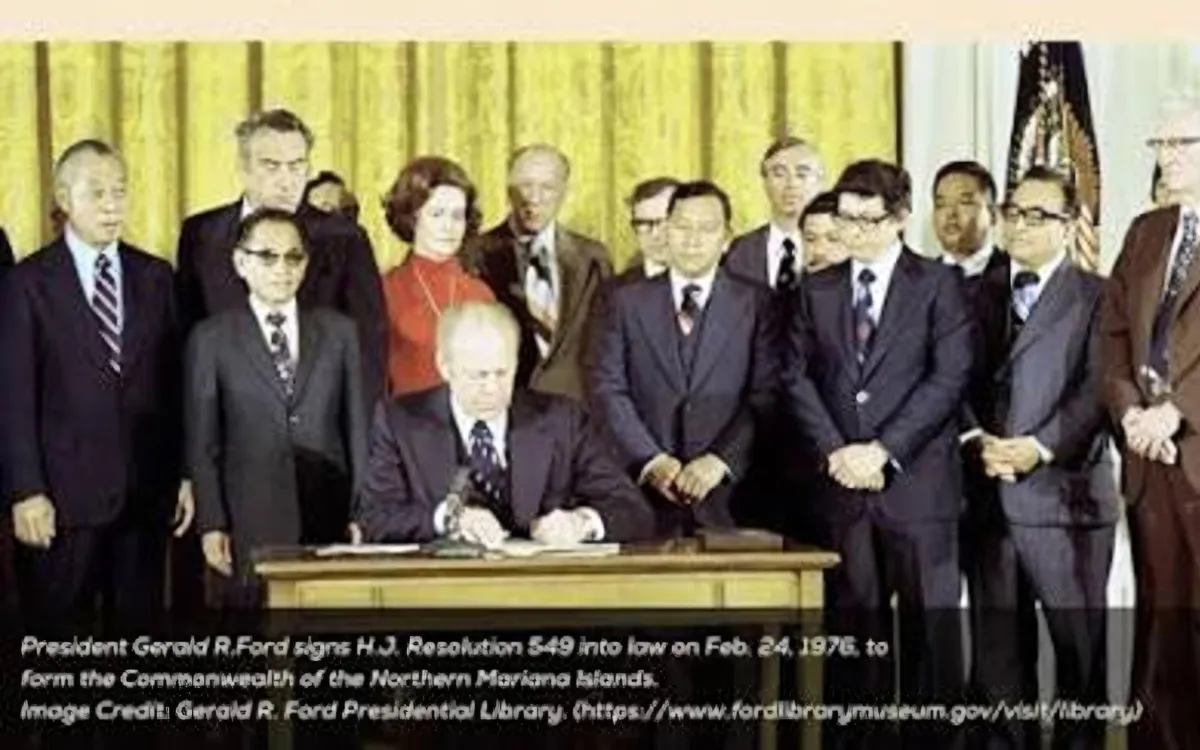
Negotiations began in the early 1970s between local leaders from the Northern Marianas and representatives of the United States. The goal was ambitious: to craft an agreement that would give the islands self-determination while preserving a close and permanent bond with the U.S. The result was the Covenant to Establish a Commonwealth of the Northern Mariana Islands in Political Union with the United States of America, later enacted as P.L. 94-241 in 1976.
The very word “covenant” carried weight. It suggested not just a law or a treaty, but a solemn promise, a relationship built on mutual consent. Under this Commonwealth Status, the Northern Marianas would draft their own constitution, elect their own governor and legislature, and manage many internal affairs. At the same time, the United States would handle defense and foreign affairs, and extend key federal programs and protections to the islands over time.
Crucially, the Covenant was not imposed from afar. It was put to the people in a plebiscite. In 1975, Northern Mariana Islanders went to the polls and overwhelmingly approved the agreement. For many voters, it was the first time they felt their voice directly shaping the political destiny of their homeland. The act of marking a ballot was more than a civic duty—it was a declaration: we choose this path, and we choose it together.
Standing Apart from the Other Trust Territory Islands
While the Northern Marianas were embracing Commonwealth Status, the rest of the Trust Territory Islands were engaged in their own debates about the future. The Marshall Islands and the Federated States of Micronesia would eventually choose Compacts of Free Association, becoming independent states in free association with the United States. Palau would follow a similar route after a long and complex political journey. Each of these nations opted for sovereignty, with the U.S. as a strategic partner rather than a political parent.
The Northern Marianas, however, chose something unprecedented: to become a U.S. commonwealth, similar in some ways to Puerto Rico, but with its own carefully negotiated terms. This made the CNMI Covenant historically significant. It was the first time a people under U.N. trusteeship voluntarily entered into a permanent political union with an administering power, based on a detailed, negotiated agreement and a democratic plebiscite. In a world still wrestling with the legacies of colonialism, this was a bold and unusual answer to the question of how self-determination could look.
The decision also reflected different priorities. Many in the Northern Marianas valued U.S. citizenship, long-term security, and economic integration with the United States more than the symbolic independence that other island nations pursued. They were willing to accept U.S. sovereignty in exchange for stability and opportunity, but only on terms that protected their land, culture, and local control. The Covenant tried to strike that delicate balance, with provisions safeguarding local land ownership and giving the CNMI a unique degree of autonomy in areas like immigration and labor—at least initially.
Building a Commonwealth: Early CNMI Development
With Commonwealth Status came new institutions and expectations. The islands adopted a constitution, created government agencies, and began to receive increased federal support. Roads were paved, schools expanded, and hospitals improved. The CNMI flag flew alongside the Stars and Stripes, and children grew up pledging allegiance to a country that now formally claimed them as its own—though full U.S. citizenship for all residents would roll out over time.
Yet the Covenant’s special provisions also opened doors that would define CNMI development in complicated ways. Because the CNMI initially controlled its own minimum wage and immigration, local leaders sought industries that could thrive under those conditions. Two sectors rose quickly: tourism and garment manufacturing. Tourists arrived to enjoy the beaches of Saipan and the history of World War II sites, while garment factories used foreign labor and favorable trade rules to produce clothing for the U.S. market.
For a time, the numbers looked impressive. Jobs multiplied, government revenues rose, and the islands experienced a kind of boom. People spoke hopefully of the Commonwealth as a success story—a tiny archipelago that had used its political status to carve out an economic niche in the global marketplace. But beneath the surface, the story was more complex. Heavy reliance on foreign workers and a single industry made the economy fragile, and reports of labor abuses in the garment sector drew national attention, raising difficult questions about how the Covenant’s autonomy was being used.
When Promises Meet Reality: Shifting U.S. Relations
Over time, the special relationship defined by the CNMI Covenant evolved. As concerns grew in Washington about labor practices and immigration control, Congress moved to apply more federal laws directly to the CNMI. The federal government eventually took over immigration and border control, and federal minimum wage laws began to phase in. The garment industry collapsed as global trade rules changed, leaving empty factories and economic uncertainty in its wake.
For many residents, this period felt like a test of what Commonwealth Status really meant. The Covenant had promised a partnership, but partnerships can be uneven when one side holds far more power. Debates flared over whether the United States was honoring the spirit of the agreement or gradually eroding the autonomy that had made the CNMI’s choice so distinctive in the first place. At the same time, federal support in areas like education, health care, and disaster response remained vital, especially as the islands faced typhoons and economic shocks.
In these ups and downs, the CNMI’s story highlights a truth that many small territories and island nations know well: political status is not a static label. It is a living relationship, constantly renegotiated through court cases, congressional hearings, and everyday governance. The Covenant set the terms of that relationship, but it did not freeze them in time.
Everyday Life in a Commonwealth: What the Covenant Means Now
Today, the legacy of the CNMI Covenant is woven into the texture of daily life in the Northern Mariana Islands. Children learn U.S. history alongside local stories of ancient voyagers and clan lands. Young adults join the U.S. military at high rates, serving a country that is both distant and deeply present. Residents travel freely to the mainland United States, yet return to communities where Chamorro and Carolinian traditions remain strong and land ownership is still carefully protected for indigenous families under local law—another promise rooted in the Covenant era.
Economically, the CNMI continues to lean on tourism, courting visitors from Asia and beyond. New debates have emerged around development, sustainable tourism, and diversification. Each policy discussion carries an echo of earlier choices: how can the islands use their unique Commonwealth Status to foster development without losing control of their future? How should they navigate U.S. relations to secure support while preserving dignity and local decision-making?
A Different Answer to Self-Determination
Looking back, the significance of the CNMI’s choice becomes clearer. While other former Trust Territory Islands raised their own flags as independent nations in free association, the Northern Marianas chose a different symbol of self-determination: a carefully negotiated place within the American political family. The plebiscite that approved the Covenant did not reject independence out of fear; it embraced a vision of security, mobility, and partnership that islanders believed would best serve their children and grandchildren.
That decision has brought both benefits and burdens. The CNMI has enjoyed access to U.S. programs, disaster relief, and a broad legal framework. It has also faced the constraints and controversies that come with being a small territory inside a much larger federal system. But the key point is that the people of the Northern Marianas were not passive subjects in this story. Through the CNMI Covenant, they crafted a distinctive political identity—neither fully like a U.S. state nor like an independent island nation, but something in between, born of history, geography, and hard negotiation.
The Covenant’s Quiet Lesson
In a world where decolonization stories are often told in terms of flags lowered and raised, the CNMI’s experience offers a quieter, more complicated lesson. Self-determination can mean independence, but it can also mean choosing an enduring partnership—on terms that reflect local values and historical realities. The Trust Territory Islands took different paths, each shaped by its own culture and priorities. The Northern Marianas’ path, through the Covenant and Commonwealth Status, shows how a small community can use law, negotiation, and the ballot box to carve out a place in a global power’s orbit without disappearing into it.
On that humid evening decades ago, when islanders gathered to debate their future, they could not have predicted every twist and turn that CNMI development would take. But they understood something essential: that history had given them a rare chance to choose. The CNMI Covenant, P.L. 94-241, was the written form of that choice—a living document that continues to shape their relationship with the United States, and a reminder that even the smallest islands can make decisions with global significance.